



Argentina's Work and Holiday Visa: The Ultimate Guide For 2026
by Jessie Chambers 2 years ago
11 MIN READ
This guide was updated on 12th of July 2026.
Ask anyone who spent a real chunk of time in Argentina how it went, and they won’t actually answer you. They’ll just get a specific kind of faraway look. They’ll inhale like they’re about to begin a TED talk. And then they’ll say something like “where do I even start” before telling you a seventeen-minute story about a stranger’s abuela feeding them ravioli at 1am in Rosario. A love story in the making is pretty much the scope.
Argentina is the working holiday destination that really adds a chapter you’ll never forget. Partly because the country itself is geographically unhinged (glaciers, deserts, jungle, pampas, Antarctica basically, all within one passport stamp). Partly because the culture runs at a specific emotional frequency that takes about two weeks to sync up with. And partly because the Work and Holiday Visa lets you live inside all of it for twelve months, which honestly should be illegal given how good the food is.
This guide walks you through how the visa actually works, the requirements people usually miss, and the specific way a year in Argentina rearranges your entire personality. Vamos!
Quick Summary
- Who: citizens of the 19 countries with bilateral Work and Holiday agreements with Argentina
- Age: 18 to 30 inclusive for most nationalities; and few lucky ducks that get the stretch to 35
- Duration: up to 12 months, non-renewable, once in a lifetime
- Consular fee: USD 150 (or EUR 150 equivalent, depending on the consulate you apply through)
- Minimum funds: USD 2,500 (or EUR 2,500 equivalent)
- Max with one employer: 6 months
- Apply: in person at the specific Argentine consulate or embassy assigned to your nationality
- Australia-specific: tertiary qualification or 2+ years of undergraduate study required, plus functional Spanish evaluated at interview, plus a letter of support from the Australian Government
Things Nobody Warns You About Argentina
Fair warning: the official guides will tell you about the weather, the exchange rate, and the dulce de leche. They will not tell you any of the following, all of which you will learn the hard way. So we’re telling you now. You’re welcome.
1. Dinner does not happen before 10pm. Arriving at a restaurant at 7pm makes you either a tourist or a British pensioner, and Argentine staff will look at you with the patient sadness usually reserved for injured birds. Lunch runs late. Dinner runs extremely late. Clubs don’t start until midnight and don’t peak until 3am. Sleep schedules here are genuinely their own dimension. Adjust.
2. The currency situation is its own full subject. Argentina has multiple exchange rates running at the same time (the “blue dollar” is real, it’s not sketchy, everyone uses it) and inflation that can genuinely shift prices between morning and afternoon. You will develop Opinions about this within a month. You will end up explaining it to your parents over the phone. You will become a part-time economist whether you signed up for that or not.
3. Argentinians will kiss you on the cheek. Upon meeting. At work. Their friend you’ve met once. Their grandmother’s neighbour’s postman. It’s one kiss, right cheek, no overthinking required. Attempting a handshake will register as mildly hostile. Lean in, literally.
4. Asado is not a barbecue. Calling it a barbecue is the kind of linguistic war crime that will get you side-eyed into next week. Asado is a full-day social event centred on slow-grilled meat prepared by a designated Asador who has spent years perfecting the craft. You will be invited to one within your first month. You will eat too much. You will be served more. This is correct. Go with it.
5. Football is not a sport. It is a religion with formal rituals, generational loyalties, and entire neighbourhood identities built around which team you support. Boca vs. River is not a rivalry, it’s a civilisation-level event. Going to a match (safely, with someone who knows what they’re doing) is one of those Big Argentine Experiences that nobody shuts up about afterwards, for extremely good reason.
Visa at a Glance
The Argentine Work and Holiday Visa is managed under bilateral agreements between Argentina and a specific list of partner countries. The conditions vary slightly depending on your nationality, so always verify your specific country’s requirements with your nearest Argentine consulate before applying.
Eligible Nationalities
Argentina currently operates Work and Holiday agreements with the following 19 countries (verify current status with the Argentine Ministry of Foreign Affairs as agreements can be updated):
- Australia, Austria, Denmark, France, Germany, Ireland, Japan, Netherlands, New Zealand, Norway, Poland, Portugal, South Korea, Sweden
Annual Quotas by Country
Argentina sets an annual quota for each bilateral partner. Confirmed quotas from the Argentine Ministry of Foreign Affairs:
- Australia: 1,500 places per year
- New Zealand: 1,000 places per year
- France: 1,000 places per year
- Poland: 400 places per year
- Ireland: 200 places per year
- Japan: 200 places per year
- South Korea: 200 places per year
- Netherlands: 100 places per year
- Portugal: 100 places per year
- Denmark, Germany, Sweden: unlimited quota
- Austria and Norway: quotas set through bilateral arrangements, confirm at your consulate
Age and Participation
- 18 to 30 inclusive for most nationalities at time of application
- 18 to 35 New Zealand, Ireland, South Korea (34) and Hungary
- Once-in-a-lifetime visa, cannot be granted again
- Holiday is the stated primary purpose; work is legally permitted but treated as secondary
How to Apply, Step by Step
Argentina’s Work and Holiday Visa is applied for in person at your nearest Argentine Embassy or Consulate-General. There’s no agency between you and the Argentine government. Processes vary slightly by country, but the skeleton is consistent.
Documents Needed (All Nationalities)
- Valid passport with at least 3 months validity beyond your intended visa expiry date, plus at least one blank page
- Completed visa application form (downloadable from your Argentine consulate’s website)
- One 4x4cm front-face photograph on white background
- Criminal record search certificate from your home country covering the last 3 years
- Sworn affidavit declaring no criminal record in any other country
- Financial evidence: 3 months of personal bank or credit card statements demonstrating a minimum of USD 2,500
- Return flight reservation or evidence of funds to purchase one
- Medical and accident insurance quote or reservation covering the full 12 months
- Motivation letter stating holiday as the primary purpose of your trip, with work as incidental (explicitly required for most nationalities)
- Payment receipt for consular fees
Additional Documents for Australian Applicants
- Certificate of tertiary studies completed, or official letter from your university confirming at least 2 years of undergraduate study completed
- Letter of support from the Australian Government backing your participation
- Evidence of functional Spanish (evaluated at the in-person interview at the Consulate General in Sydney)
- Hotel booking or accommodation evidence for the initial period of the stay
The Application Process
- Confirm your eligibility: nationality, age, any nationality-specific education or language requirements
- Gather your supporting documents: police clearance and insurance documents take the longest to prepare
- Sort your insurance: Global Work & Travel Cover
- Book your consular appointment: Argentine consulates require in-person appointments. Book early, slots can fill weeks in advance
- Attend your appointment in person: bring originals plus copies of every document. Expect a brief interview about your plans (and for Australians, a functional Spanish evaluation)
- Pay the consular fee: depending on your consulate, these prices will vary
- Wait for processing: you can expect to wait anywhere between 6-8 weeks minimum, we always suggest planning and getting in touch with 6-12 months lead time
- Receive your visa and book flights: you’ll get a visa sticker or stamp in your passport. The 12-month clock starts when you enter Argentina
- On arrival in Argentina: get your CUIL (local tax ID) if you plan to work legally. Most employers will need this
Work Life in Argentina
The Argentine Working Holiday Visa permits work across most sectors, with a strict cap of 6 months per employer. Hospitality, tourism, and language teaching are the standard entry points. English speakers are in reasonable demand across the tourism-heavy regions, and Buenos Aires has a growing creative and tech scene that hires casually.
Depending on your level of experience and what kind of working holiday you’re actually after, there’s a little something for everyone. Want to be super social and get a chance to meet lots of other travellers, hospitality may be the shout. If you’re keen for an immersive experience, you could opt in for working on a wine farm… 2pm vino anyone?
- Hospitality and hostels: bars, cafes, restaurants, and hostel receptions in Buenos Aires (Palermo, San Telmo), Mendoza, Bariloche, and El Calafate. English speakers are actively sought in tourist-facing roles
- Language teaching: private English tutoring and language academies in Buenos Aires, Córdoba, and Rosario
- Ski and adventure seasons: Bariloche and Las Leñas during the June-to-September ski season. Patagonia tour companies hire guides, instructors, and front-of-house staff seasonally
- Wine harvest in Mendoza: vineyard and winery work during February-to-April harvest season. Some farms offer room and board alongside paid work
- Tour guiding: multilingual travellers can find work leading tours through Buenos Aires, Mendoza, and the Patagonian circuit. Good base pay plus tips
- Creative and freelance work: Buenos Aires has an active digital creative community and remote-friendly co-working scene. If you have existing clients abroad, your money goes dramatically further here
Places You Need to See
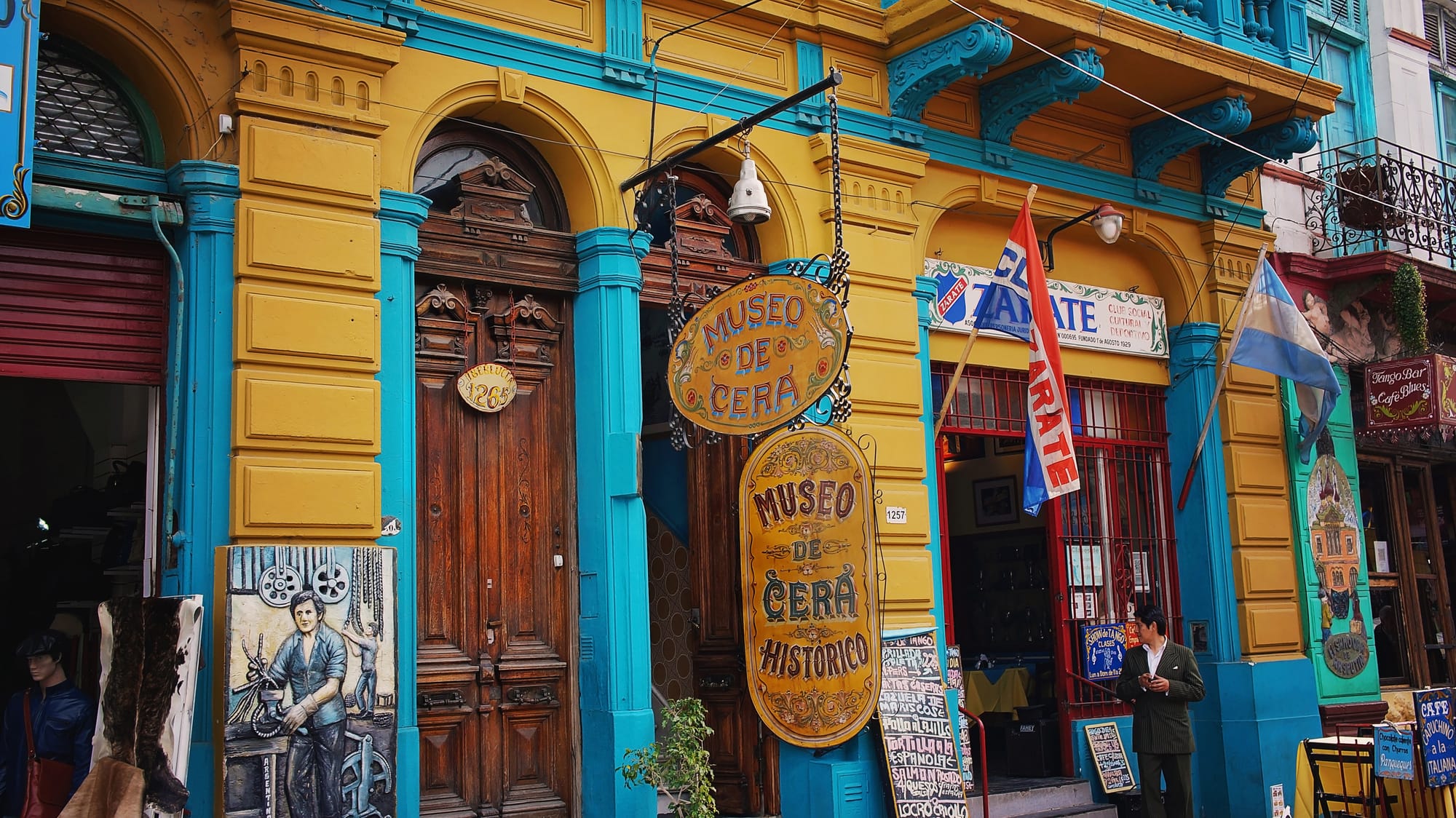
Buenos Aires is less one city and more seven cities awkwardly sharing a postcode, and you need to learn the difference quickly. Palermo is leafy, hipster-adjacent, and where you’ll probably end up living (we highly recommend). San Telmo is old-school with cobblestones, antique markets, and genuine milongas where tango actually happens (not the tourist shows, the real ones). La Boca is colourful, working-class, photogenic, and genuinely not safe to wander off the main streets after dark. Recoleta is where the money lives. Villa Crespo is where Palermo used to be before Palermo got expensive. Learn these in week one.
Mendoza is wine country, but saying “wine country” undersells it by a significant margin. The Andes are right there. Malbec vines stretch to the horizon. You can rent a bicycle and cycle between vineyards, tasting as you go (some of which are world-class, most of which are honestly unreal for the price). The city itself is leafy, slow, and built around an earthquake-proof grid of irrigation channels. Send it for a long weekend. Send it for a month. Send it for harvest season and work there.
Patagonia isn’t one place, it’s a full regional identity spanning both Argentina and Chile, and the Argentine side has genuinely some of the most iconic landscapes on the planet. El Calafate gets you to the Perito Moreno Glacier, which actively calves huge sheets of ice into the lake while you watch. El Chaltén is the trekking capital of the country, with Mount Fitz Roy as the backdrop. Ushuaia is the southernmost city on earth and the launch point for Antarctic cruises if you’re feeling unhinged about it. Do not rush this region.
Iguazú Falls on the border with Brazil is one of the natural wonders of the world, and the Argentine side gives you the close-up perspective while the Brazilian side gives you the panoramic view. Ideally you cross the border and do both. The “Devil’s Throat” walkway puts you directly above the main cascade. You will get drenched. Your camera will complain. The rainbows literally never stop.
Bariloche is the lake-district town that somehow combines Swiss chalet architecture, Argentine chocolate culture (yes, that’s a thing), world-class skiing in winter, and hiking in summer. People go for a week and extend for a month. The Ruta 40 drive through the region is on every serious road-tripper’s bucket list. No notes.

Settling In: The First Month
The first few weeks in Argentina involve a specific mix of romance (discovering your cafe, your empanada place, your walk home), bureaucracy (the CUIL, the bank account, the exchange rate), and cultural recalibration (dinner at 11pm). Build in patience. Everything takes longer than you expect and once you find your rhythm it will feel like home!
- Accommodation: most travellers start with a week in a hostel in Palermo or San Telmo, then move to a shared flat.
- CUIL (tax ID): you’ll need one to work legally and open a bank account. Apply at the ANSES (social security administration) office with your passport and visa. Free, takes about an hour
- Currency strategy: this is the one that catches people. Do not exchange money at the airport or at official bank rates. Everyone uses the “blue dollar” (parallel rate) via Western Union transfers or via trusted money changers (cuevas). It’s legal for foreigners, it’s significantly better than the official rate, and your budget will literally feel different
- MercadoPago: Argentina’s version of PayPal/Venmo combined, used for almost every casual transaction. Downloading it in the first week is honestly essential
- SUBE card: the public transport card for Buenos Aires. Buy one at any kiosco (corner store), load it up, and you’re set for the metro, buses, and trains
- Spanish: Argentine Spanish is distinct. The “ll” and “y” sounds come out as “sh” (calle = “cashay”, not “cayay”). “Vos” replaces “tú.” Slang is extensive. It’s all mutually intelligible with other Spanish, but your first week will involve genuine “wait, what” moments
Ready to Go?
Argentina’s Work and Holiday Visa is one you apply for directly at your nearest Argentine Embassy or Consulate. Global Work & Travel doesn’t package the visa itself, but we do run a proper cluster of Argentina-specific experiences that slot into the year at different moments.
The Cultural Deep-Dive (Any Time During Your Year)
Cooking in Buenos Aires: a short Argentine cooking course that teaches you how to actually make empanadas, asado, milanesa, and the other staples you’ll be eating three times a week anyway. Do this in your first month and you can cook for your new flatmates. Do it later and it becomes the souvenir you bring home forever. Either way, you stop being a tourist at the asado and start being useful. No notes.
Tango in Buenos Aires: formal tango lessons in the city where tango was invented. Argentine tango is not the sparkly ballroom version. It’s a close, improvisational, emotionally loaded social dance with proper codes and etiquette. Learning it at a milonga in Buenos Aires absolutely hits different from learning it anywhere else on earth. Main character energy, genuinely earned.
The Regional Combo (Stack With Peru)
Lima Tour + Buenos Aires: if you’re already booked for Argentina and you want to extend the Latin American era into Peru (Machu Picchu, Lima food scene, Sacred Valley), this combo tour makes the geography and logistics make sense. Especially useful before or after your 12 months, when you’re already in the region and flights are cheap.
The Practical Layer (All Year, Every Day)
Global Travel Cover: your medical and travel insurance. Argentina’s Working Holiday Visa application requires valid health cover that includes medical care and repatriation, and the visa runs 12 months, so you need a policy built for longer stays and for the specific adventure-heavy things you’ll absolutely do here (Patagonian trekking, ski season in Bariloche, horse riding in the pampas, the occasional questionable Bolivian bus ride). This is the insurance piece that makes the paperwork actually go through.
Final Thoughts
Midnight asados. Malbec at Mendoza vineyards. Tango in San Telmo. Empanadas from a stall where the abuela remembers your order by week two. Perito Moreno literally breaking off glaciers while you watch. A Spanish accent that will absolutely humble you. A currency situation that will turn you into an unlicensed economist. One of the most geographically and culturally rich working holiday destinations on earth, for twelve months, once per lifetime. If you’ve got the passport and the degree, the move is getting to your consulate. The best year of your life is literally only a handful of months away!
If you want to learn about the digital nomad visa's for other countries, we have extensive guides for countries like the United Kingdom, Germany, New Zealand, Italy, Portugal, Spain, Thailand, and Japan.
We also publish extensive working holiday visa guides for United States, Canada, Australia, United Kingdom, Germany, France, Spain, Italy, Ireland, Norway, Korea, Argentina, Chile, Hong Kong, Estonia, Netherlands, Austria, Slovakia, Portugal, Peru, Greece, Singapore, Malaysia, Taiwan, Mongolia, Indonesia, Vietnam, Thailand, New Zealand, Chile, Ecuador, Brazil, Israel, Czech
Republic, Mongolia, Papua New Guinea, and more coming.

Jessie Chambers
Jessie is a globetrotter and storyteller behind the Global Work & Travel blog, sharing tips, tales, and insights from cities to remote escapes, informed by the collective experience and real-world knowledge of teams across our business.