



Portugal Working Holiday Visa - The Complete Guide For 2026
by Jessie Chambers 2 years ago
9 MIN READ
POV: it's a Tuesday, you're sitting on a tiled step in Alfama with a custard tart that's still warm, a tram rattles past close enough to touch, and somewhere below you the Tagus is turning gold right before sunset. You have nowhere to be. This is just your life now.
Portugal has a way of making the ordinary feel cinematic. Mornings smell like espresso and sea air. Afternoons are cobbled hills, hand-painted azulejo tiles on every other wall, and a coastline that swings from glassy surf to dramatic cliffs in the space of a bus ride. Evenings are tiny restaurants, a bottle of vinho verde for the price of a sandwich back home, and a fado singer somewhere making the whole room briefly emotional.
And the surf. We have to talk about the surf. The Algarve and the west coast serve up some of the most accessible waves in Europe, the kind you can roll up to as a total beginner and still walk out of grinning.
This guide is the full picture: what the Portugal Working Holiday Visa actually is, who can get one, how the year really works, and how to bolt on an adventure you'll be talking about for years.
What the Portugal Working Holiday Visa Actually Is
Good news up top: unlike a lot of countries people assume have one, Portugal genuinely does.
It's officially called the Youth Mobility visa, though most people search for it as the working holiday visa, and it lets young travellers from a specific set of countries live, work, and travel in Portugal for up to 12 months. It exists thanks to bilateral agreements (Memoranda of Understanding) Portugal has signed with ten countries, so whether you can get one comes down entirely to your passport.
Because Portugal sits inside the Schengen area, the visa is issued as a Type D national visa. That's the quiet superpower: while it's valid, it doesn't just unlock Portugal, it lets you travel the rest of the Schengen zone for up to 90 days in any 180-day window. Weekend trips to Spain, France or Italy are part of the deal, not a separate visa headache. One application, a whole continent within reach.
Portugal Working Holiday Visa at a Glance
- Who it's for: young travellers from one of ten countries with a youth mobility agreement with Portugal.
- Age: generally 18 to 30 inclusive, with some nationalities eligible up to 35. The exact cap depends on your passport.
- Duration: up to 12 months. Not extendable, and you can't hold it twice.
- Work rule: work is incidental to the holiday, capped at six months, with no permanent contract.
- Funds and cover: proof of savings, a return ticket or the means to buy one, and valid travel and health insurance.
- Fee and timing: roughly €90, processed in around 30 to 60 days. Confirm both with your consulate.
- Where to apply: your nearest Portuguese embassy or consulate.
Why Portugal Hits Different
Park the paperwork for a second, because here's why Portugal has quietly become everyone's favourite year abroad.
It's Europe without the European price tag. Your money stretches in a way it simply doesn't in Paris or Amsterdam: a proper lunch for a handful of euros, rent that doesn't make you cry, a train to the beach that costs less than your morning coffee habit. That gap is the whole game. It's what turns a tight budget into a year of actually doing things instead of just looking at them.
Then there's the location. Portugal is the launchpad. Lisbon to Seville on a cheap flight, Porto to the rest of Europe in a couple of hours, Morocco close enough to make a long weekend. You're not stuck in one country, you're plugged into a continent.
And the people. The Portuguese are warm in an unshowy way, the kind who'll correct your terrible Portuguese with a smile and then feed you anyway. You came for the tiles and the tarts. You'll stay because somewhere around month three it stopped feeling like a trip and started feeling like home.
Then there's the rhythm of an ordinary day, which is the part the postcards undersell. Coffee and a pastry that costs less than a euro. A long lunch nobody's rushing. A surf after work because the beach is right there. Late dinners, cheap wine, grilled sardines, and a sunset that turns up on cue. It's not a holiday you're cramming into two weeks, it's a pace of life you get to keep for a year, and that's the bit that quietly ruins you for everywhere else.
The Visa, Explained Simply
So how does the year actually work once you've got the visa? Cleaner than you'd expect.
The whole thing is built around one idea: you're here for the holiday first and the work second. Officially, work is "incidental" to your stay, which translates to a few real limits. You can work for up to six months of your twelve, you can't take a permanent contract, and some agreements cap how long you can stay with a single employer. Within those lines, you're free to pick up the kind of work that funds the trip.
You can also study. The visa allows training or study courses of up to six months, so if you want to spend part of the year learning Portuguese or picking up a skill, that's built in rather than bolted on.
Two things to plan around. The visa isn't extendable, and it's once-only: after you've held it, you can't reapply. It also leans hard on your insurance, valid travel and health cover for hospital care and repatriation across your whole stay is a firm requirement, not a nice-to-have, so sort that early.
Who Can Apply, and the Fine Print by Country
The visa is only open to passport holders from the ten countries that have signed a youth mobility agreement with Portugal. After that, the detail is in your specific deal:
- The ten eligible nationalities: Argentina, Australia, Canada, Chile, Japan, New Zealand, Peru, South Korea, the United States, and Uruguay.
- Age limits vary: most agreements run 18 to 30 inclusive, but some, including Canada and Uruguay, stretch to 35. Check the exact cap for your passport before you bank on it.
- Language can matter: a few agreements ask for functional Portuguese, around A2 level. Most don't, but yours might.
- Education can matter: some agreements ask for tertiary study or a completed qualification. Again, it's passport-specific.
The golden rule: because every country's deal is slightly different, the only source worth trusting for your exact requirements is the official Portuguese visa portal or your consulate. Don't take a random checklist as gospel.
How to Apply
The process is consulate-based rather than fully online, so build in a little lead time. The broad steps:
- Confirm your eligibility. Check your passport is on the list and that you meet your country's specific age, language, and education terms.
- Gather your documents. Passport, application form, proof of funds, return ticket or the means to buy one, travel and health insurance, a clean criminal record check, and any country-specific extras.
- Sort your insurance early. Cover for the full stay, including hospital care and repatriation, is required, so don't leave it to the final week.
- Submit to your nearest Portuguese embassy or consulate. Some locations use an online form first, then an in-person or postal submission. You pay the fee at this stage.
- Wait, then travel. Processing usually runs around 30 to 60 days. Once it's approved, the year is yours.
Miss a single document and the whole thing stalls, so a careful once-over before you submit is well worth the extra hour.
Work Life in Portugal
With the holiday-first framing, the work that suits this visa is flexible, seasonal, and people-facing. The most accessible routes:
- Hospitality and tourism: bars, cafes, restaurants, and hostels across Lisbon, Porto, and the Algarve hire seasonal staff constantly, and it's the fastest way to a paycheck on arrival.
- Surf and adventure: the west coast and the Algarve run surf schools, hostels, and tour operators that love hiring working travellers for the season.
- Seasonal Algarve work: the summer tourism boom along the south coast means short, intense stints that pair neatly with the six-month work cap.
- English tutoring: there's steady demand for conversational English, and it tends to slot around the rest of your week.
You can absolutely line all of this up yourself once you land, and plenty of people do. It works. It's also slower and less certain than arriving with a plan, and those first few weeks of job-hunting in a new city can eat into both your savings and your nerve.
The Add-On Adventure: Spain, Portugal & Morocco With Us
Here's where Global Work & Travel comes in, because while the visa itself is yours to sort, the adventure around it is where we can take the wheel.
There's no working holiday package for Portugal, so we won't pretend there is. What there is, and what pairs perfectly with a year on this visa, is the Spain, Portugal & Morocco tour: a 16-day run across three countries and two continents. Think Gaudí in Barcelona, Moorish Seville and Granada, a tapas crawl, then down into Lisbon and the Algarve before crossing to Morocco for the blue-washed streets of Chefchaouen, the maze-like medinas and souks of Fès, and the full sensory overload of Marrakech.
It's the ideal bookend to a working holiday: do it in your first weeks to find your feet and your people, or save it for the end as a victory lap once your visa year wraps up. A group leader handles the route and the logistics, you get an instant crew, and all the transport between stops is sorted, so you arrive with the setup already in motion.
It isn't the budget way to see three countries, and we'll be straight with you about that. What it buys you is speed, a ready-made group, and someone else untangling the cross-border logistics while you're busy having the time of your life. Big night out in Lisbon included, obviously.
Places You Need to See
Lisbon. The capital that runs on hills, trams, and golden light. Get lost in Alfama's alleys, ride Tram 28 like the temporary tourist you are, eat your body weight in pastéis de nata, and wind up at a miradouro watching the sun drop over the river with half the city beside you. We will hear no slander against Lisbon and that's that on that.
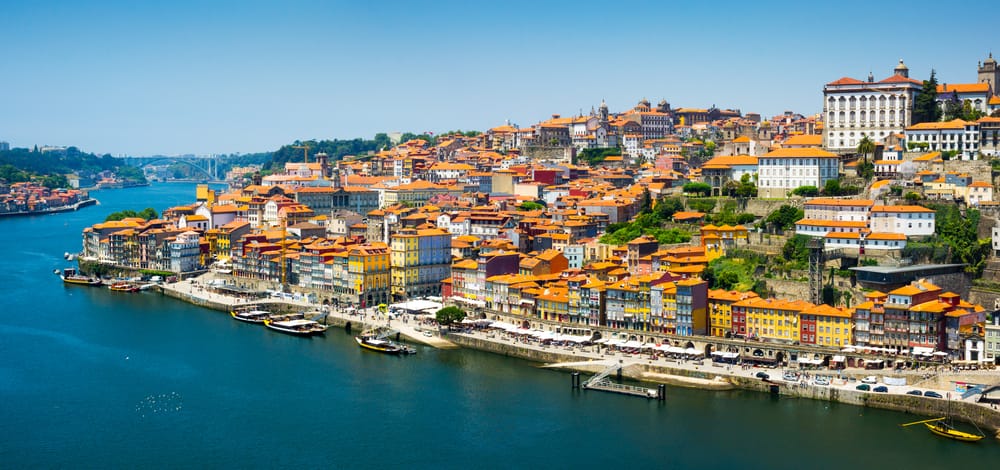
Porto. Lisbon's moodier northern sibling, all tiled facades, port cellars across the river, and a riverfront that begs you to do absolutely nothing for an entire afternoon. Colder, grittier, arguably cooler. The francesinha sandwich alone is worth the train fare.
The Algarve. Portugal's south coast and the reason your camera roll is about to become unbearable. Golden cliffs, hidden coves, sea caves you reach by kayak, and beach towns that go full party in summer and full sleepy in winter. Pick your season, pick your entire personality.
Sintra. A short hop from Lisbon and basically a fairytale someone forgot to wake up from. Pastel palaces, misty forests, and a hilltop Moorish castle, all crammed into one ridiculously photogenic day trip. No because how is this a real place you can just get a train to.
Madeira. The wildcard, way out in the Atlantic. Volcanic peaks, levada walks through cloud forest, and swimming in natural lava pools. If your year needs one properly epic long-weekend flex, this is the one to book.
Sorting Your Cover
Insurance isn't optional here, and that's true on two fronts. The working holiday visa requires valid travel and health cover for your whole stay, and the Spain, Portugal & Morocco tour doesn't include insurance in its price, so it's on you to organise either way.
That makes Global Travel Cover an easy call. It's built for exactly this kind of year: a $0 deductible, snow sports covered as standard if you duck off to the Pyrenees or the Alps, a 24/7 worldwide emergency line, and the flexibility to buy or renew from anywhere, even once you've already left home. For a visa that demands cover and a multi-country trip that crosses into Morocco, having one policy you actually trust behind you is the difference between a minor hiccup and a real crisis.
Final Thoughts
Portugal is the rare year abroad that delivers on the fantasy and the spreadsheet at the same time: tiles and tarts and surf and sunsets, funded by a visa that lets you work just enough to keep the whole thing rolling.
If your passport's on the list, the door is properly open, and it doesn't stay open forever, since you only get to do this once. Sort your cover, plan your route, and think about bolting a Spain, Portugal & Morocco adventure onto either end of the year while you're at it. Twelve months sounds like a lot until you're in it, and then it's surf mornings and tram rides and weekend trains to Spain, and suddenly you're counting the weeks you have left instead of the ones you've had.
Some countries you visit. Portugal you move into for twelve months and spend the rest of your life trying to get back to.
We also publish extensive working holiday visa guides for United States, Canada, Australia, United Kingdom, Germany, France, Spain, Italy, Ireland, Norway, Korea, Argentina, Chile, Hong Kong, Estonia, Netherlands, Austria, Slovakia, Portugal, Peru, Greece, Singapore, Malaysia, Taiwan, Mongolia, Indonesia, Vietnam, Thailand, New Zealand, Chile, Ecuador, Brazil, Israel, Czech
Republic, Mongolia, Papua New Guinea, and more coming.

Jessie Chambers
Jessie is a globetrotter and storyteller behind the Global Work & Travel blog, sharing tips, tales, and insights from cities to remote escapes, informed by the collective experience and real-world knowledge of teams across our business.